
What's the prognosis?
In one form or another, this is always part of the discussion when someone is diagnosed with a serious disease. And I've found it difficult to answer that question when I've been asked by people diagnosed with Parkinson's because the literature is not so clear.
Of course the individual articles are thorough, validated through the peer-review process and scientifically rigorous. They include analyses that help understand the prognosis - as shown by this study of the risk of falling down - a big problem as Parkinson's gets worse. But they often look at only one risk or produce complex mathematical models that are tough to use or to explain to a patient.
Several studies published since the 1970s are interpreted as evidence that levodopa therapies improve lifespan - but they actually don't. The problem is that the characteristics of people enrolled in each study were different which could be the main reason for the different lifespans reported (such as age, whether they were studied at the onset of disease or later in its course, identified by a hospitalization or from medical records, etc.). And by shifting the conversation to that comparison, we lose sight of what people want to know when they hear the diagnosis: "What is my future?"
I'm not sure survival rates would tell enough of the story. If those with Parkinson's give me some latitude to offer an opinion, what I saw my buddy Ivan experience taught me that the effects on his function and independence were bigger problems for him than lifespan. He felt dehumanized and irrelevant.
Last week a paper was published that changes things for me. In a terrifically thorough manner, these investigators used six different databases from countries where the medical system assures that everyone diagnosed with a disease is part of a national database. So while the patients were almost all white - a shortcoming - the data were collected from everyone diagnosed with Parkinson's disease starting at the time they were first diagnosed with the disease and continuing for over 5 years on average and up to 12 years.
The authors were scientific and detailed in defining their terms, which I'll share using language that I hear from patients. This study allows us to understand the prognosis for people diagnose with Parkinson's suffering from 4 important problems; independent Functioning, likelihood of Falls, onset of Forgetfulness and risk of Fatality. (Note my labeling is not exact but meant to make it easier to remember for people with the disease and their families.)
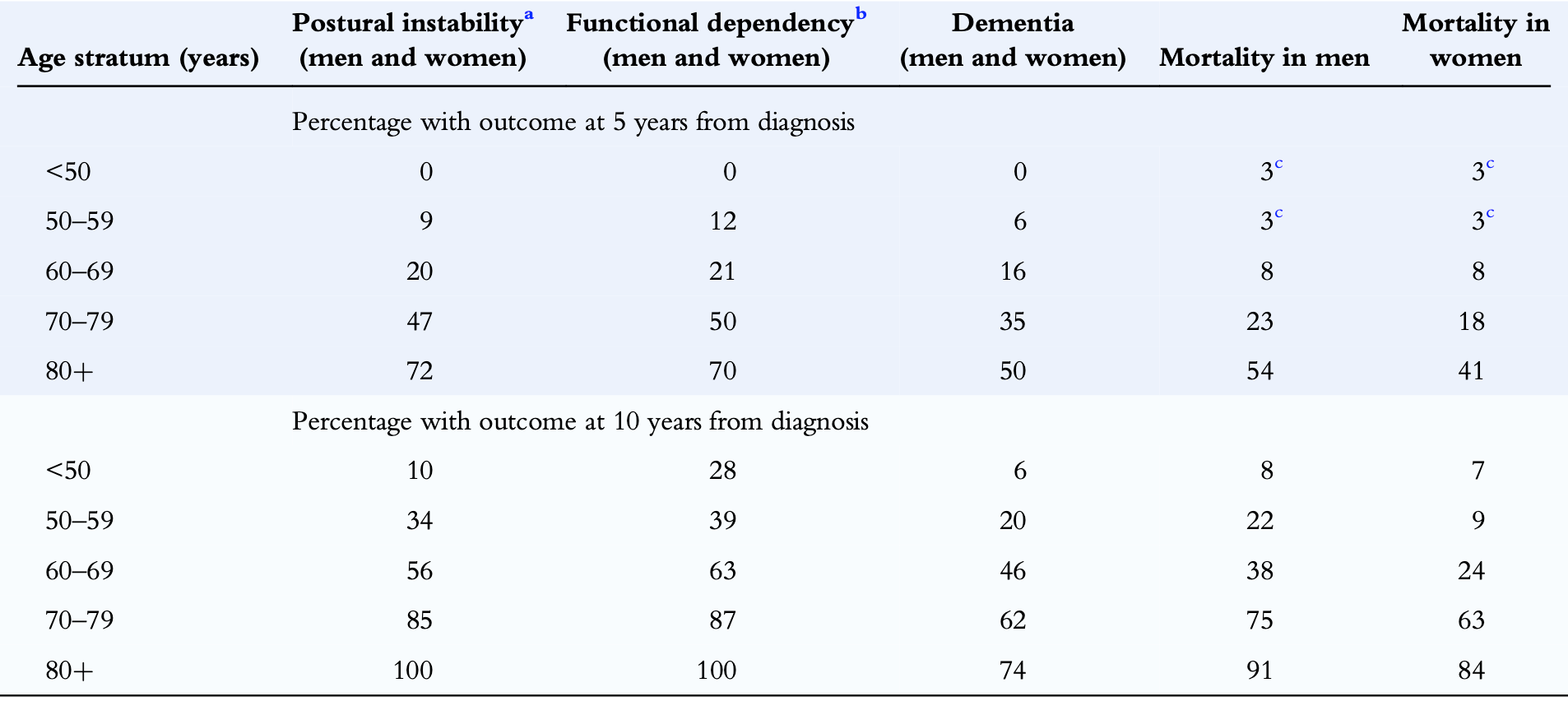
They report the hazards for each of the "4 Fs" as likelihood in 5 years and in 10 years from diagnosis.
- At least one Fall for 34% within 5 years and 69% within 10 years
- Loss of independent Function for 36% within 5 and 71% within 10 years
- Forgetfulness starts for 26% within 5 years and 50% within 10 years
- Fatality happens for 19% within 5 years and 55% within 10 years
These should be considered in the context of decreasing function over time. While this is depressing information people need information to understand their future and plan for it.
And they show details for each of the "4 Fs" depending on the age of diagnosis, which I show below:›
People with the disease need to understand their prognosis. And people caring for those with Parkinson's need to communicate the prognosis in ways that are understandable.
This is the best way I can find to discuss prognosis, but I am open to hearing from others if they identified other or better approaches.
Share This
|
Sign up at: ParkinsonsDisease.blog |
About Jonathan Sackner-Bernstein, MD
Dr. Sackner-Bernstein shares his pursuit of conquering Parkinson's, using expertise developed as Columbia University faculty, FDA senior official, DARPA insider and witness to the toll of PD.
Dr. S-B’s Linkedin page
RightBrainBio, Inc. was incorporated in 2022 to develop tranformative therapies for people with Parkinson's.