
My Journey
How did a cardiologist become a Parkinson's researcher? Learn how Ivan and the science drove the process.
"What is a cardiologist doing researching Parkinson's?"
I can't count how many times I've heard that question. Sometimes it's driven by curiosity, others by skepticism. If you heard me share previously, please bear with the redundancy. It is a simple question with a long answer.
Years ago, my buddy Ivan started to worsen. His Parkinson's was noticeable for a while, and by the mid 2010s, it was clear things were changing. The medicines did not work so well anymore. His mobility was less. His fine motor skills were affected. But his cognitive skills and emotional intelligence remained unparalleled. That's why I was confused by his insistence that I could help him with his PD. After all, I was only a cardiologist and not a neurologist. But he persisted as only he could (imagine a really smart, incredibly caring, pushy New Yorker - and a lovable one).
The Intellectual Challenge
After months of this, I couldn't take it any more. I told Ivan I would read about Parkinson's and prove to him that there was no medical/scientific way I could help. That was November 2017. I started right after Thanksgiving. My approach was to start with a couple of current textbooks to get a sense of where the field was focused and then go back to the start of the modern era read the high profile scientific publications sequentially. I started with 1958, which was when Arvid Carlsson discovered that dopamine was a neurotransmitter.
I saw multiple references to a series of papers from an Austrian lab led by Oren Hornykiewicz - published in German. These 4 papers were cited as demonstrating that the brains of people with PD lacked normal amounts of dopamine. In one, dopamine was replaced with levodopa treatment and movement promptly improved. I wanted to read these papers - not just their abstracts or other peoples' summaries. But I could not find them. (Later I found a translation published 20+ years later but I did not know that existed back in 2017.)
When I worked at Columbia University, I used to love going to the library's sub-basement to read medical studies from the early 1900s. The insights were impressive and useful. I called the library and learned it no longer had the journals, eventually learning they were donated to the New York Academy of Medicine. I called and made an appointment with a librarian; the public was not allowed to touch the old journals. I gave them the citations and they returned with copies of the articles. They were mostly interested in protecting the bound journals so did not lay each page flat on the copy machine - that could damage the binding.
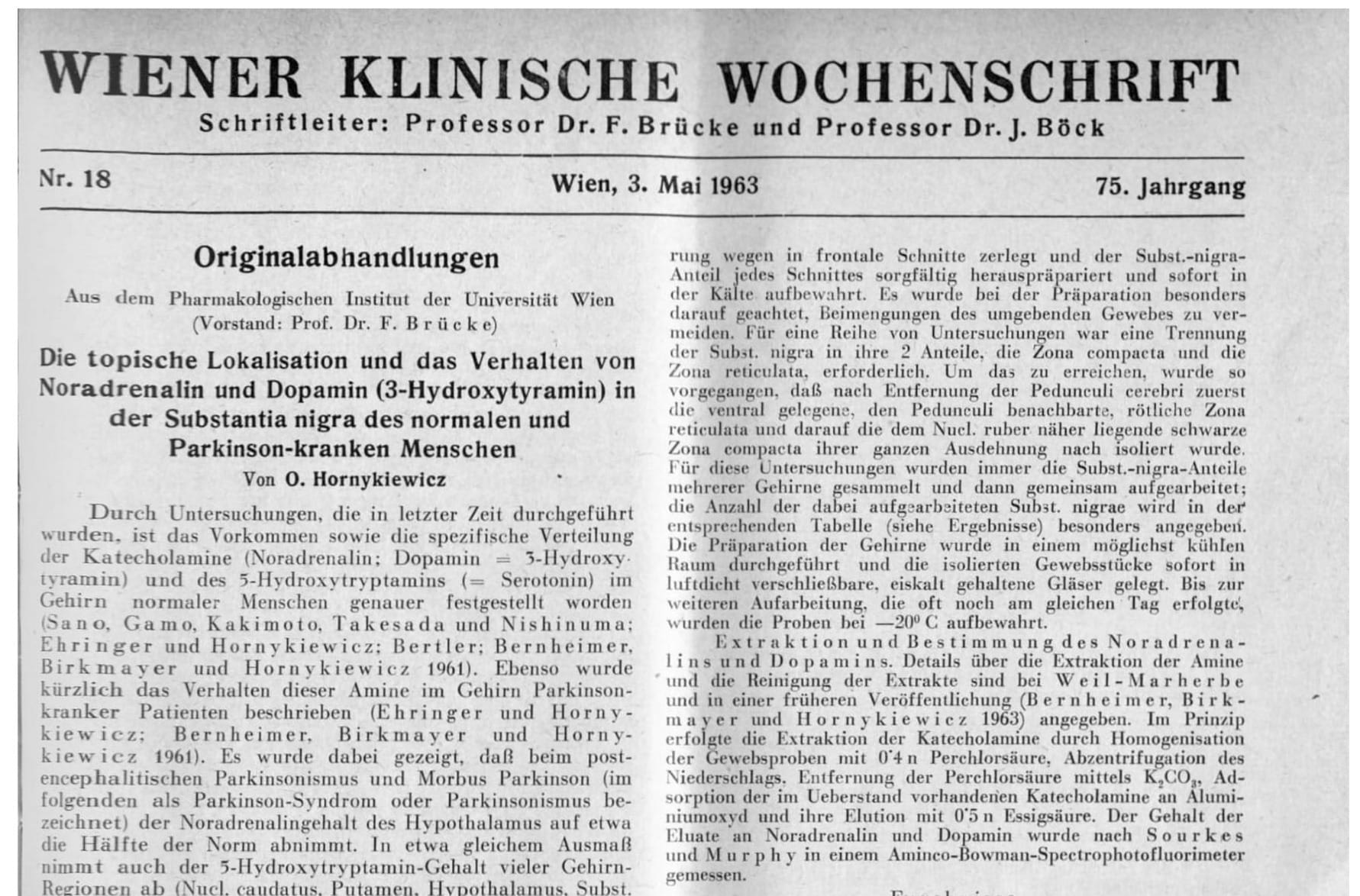
I tried to use a translation site, but it couldn't read the files confidently. So I typed in the methods section text - in German - into google translate to understand the methods. And once I did, I could evaluate these studies in the context of what came later, specifically the ways that scientific methods advanced, that knowledge expanded and that new insights became possible. These studies from the 1960s remained valid but the studies that followed showed that these results were misleading. Brain tissue levels of dopamine do not determine health vs. disease.
Biases - Both Good and Bad
We all have biases, and typically biases are considered bad. Preferring a particular view or model of disease makes it harder to see an alternative as viable. That's bad. We don't want to accept every possibility without sufficient scrutiny, but also don't want to dismiss new ideas simply because they are new.
I brought two biases with me as I started to read about PD. First, I did not believe the disease was simply a state of dopamine deficiency. We have a wide range of treatments that potently and reliably increase brain dopamine and/or its activity - yet they don't fix the disease. Second, after spending 15 years in cardiology, I looked at diseases based on those experiences and scientific lessons. And heart failure/transplant is not the same as PD/movement disorders.
As I moved from clinical trials to basic science, the biochemistry, molecular biology and genetics of Parkinson's seemed to parallel heart failure. Each is driven by communication between cells using a chemical class called monoaminergic peptides - dopamine vs. norepinephrine. Each communicates via cell surface receptors that are coupled through G-proteins. Each disease is associated with loss of the key cells as well as their dysfunction - dopaminergic neurons vs. cardiomyocytes. And these cells that determine health vs. disease can work better with production of more of their monoaminergic peptide while also being at risk of further cell dysfunction and cell loss with long-term increased production of their monoaminergic peptide (dopamine vs. norepinephrine).
My bias as a cardiologist is driven strongly by my experience working within a group of cardiologists who showed the protecting cardiomyocytes from the long-term elevated exposure to its monoaminergic peptide norepinephrine could reverse cell dysfunction and heart dysfunction, manifest as improved quality of life and reduced risk of death.
With all the biologic parallels between the diseases, could it be possible that a similar strategy could work for PD, that what it needed was a treatment to reduce dopamine? I realized how crazy this seemed, especially since I did not see evidence that dopamine levels were excessive to a point that caused toxicity, which would be necessary to show before believing this idea was worth pursuing.
How Much Dopamine?
By the1980s, the scientific literature taught that the determinant of neuron function/dysfunction is the amount of dopamine inside the neurons as well as where the dopamine is distributed within the neuron. No one had reported this value. And I am not a lab scientist, so I couldn't measure it. I am decent at math, and realized I could develop a mathematical model to estimate the amount of dopamine inside the neurons. Turns out, the dopaminergic neurons in people with PD have markedly elevated amounts of dopamine. That means that they have markedly elevated amounts of dopamine breakdown products - and these metabolites are toxic. That's right - too much dopamine can cause neuron dysfunction and loss, which explains the pathology and biology of PD.
Is this an association or a cause? We can find out by reducing dopamine, which is what several labs have done using RB-190, and each learned that in their laboratory model, reducing dopamine reverses disease pathology. RB-190 was tested in 9 different models - much more than is typical for assessing a new drug - and every measure of pathology was reversed.
I met with the FDA which agreed the next step would be a clinical trial.
Fundraising
With patent applications under review in US, EU and China, I formed a company and started fundraising. It's been slow, but we've secured support from a group of amazing investors - each touched by PD directly or indirectly and each with professional background in finance or entrepreneurship.
We've manufactured drug, secured a first-rate group of collaborators to conduct the study and are nearing submission of our application to conduct the first trial in Australia - anticipating dosing and clinical proof-of-concept data in 2027.
The Personal Connection
I did not figure this out in time to help Ivan, though as his condition worsened he whispered words of encouragement to continue on this path. I have two other friends with PD, one diagnosed ~2021 and the other earlier this year.
Those of us touched by PD - directly or indirectly- know how desperately we need a new approach, how desperately we need new treatments. The data suggest that RB-190 could be that treatment.
You can help. Let's amplify the conversation. Forward this story to 5 people. And stay tuned for further progress.
Share This
|
Sign up at: ParkinsonsDisease.blog |
About Jonathan Sackner-Bernstein, MD
Dr. Sackner-Bernstein shares his pursuit of conquering Parkinson's, using expertise developed as Columbia University faculty, FDA senior official, DARPA insider and witness to the toll of PD.
Dr. S-B’s Linkedin page
RightBrainBio, Inc. was incorporated in 2022 to develop tranformative therapies for people with Parkinson's.