
Faster. Cheaper. Better.
Project managers and departments heads told me the same thing. When planning a project, decide which are the two most important of faster, better or cheaper – and then relentlessly pursue those two. That made sense; the results on a small budget given little time seem unlikely to be as good as would be possible with more resources and more time.
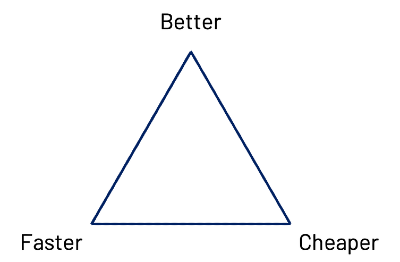
Let's consider an exception. In the 1990s, NASA faced major budget cuts in parallel with a recent big budget failure. Dan Goldin (the NASA Administrator) challenged the Agency personnel to launch projects where all three goals needed to be met – faster, better AND cheaper (FBC) – with the understanding that would require greater flexibility, intellectually and operationally. They succeeded with several projects using this FBC model including such high profile projects as the Mars Pathfinder.
Right Brain Bio: Faster, Better and Cheaper
From day 1, we've embraced NASA's FBC model for our development of RB-190 to conquer Parkinson’s. We were not aware of this model when we started and were not the first company to adopt this model. But the approach is so main-stream that there are FDA regulations that define how to apply this FBC model to drug development – called the 5050(b)(2) pathway.
This 505(b)(2) pathway allows for an existing drug to be developed for a new use, skipping preclinical and Phase 1 testing.
Faster:
RB-190 gets to Phase 2 immediately. For a new drug that can take 5-7 years, if not longer.
Better:
Many drugs fail in development because of “off-target safety” problems. Examples include ximelagatran, which you probably never heard of because during its clinical trials, this medicine to reduce blood clots was shown to injure the liver. It did not have an on-target problem – it was a very good drug to reduce blood clots. But hat off target liver problem prevented it from getting onto the market. According to industry data, approximately 13% of new drugs for neurologic diseases successfully complete Phases 1 and 2. RB-190 skips Phase 1; the Phase 2 success rate for a repurposed drug is 38% - almost 3x higher.
Cheaper:
Because RB-190 skips Phase 1 and does not testing and go directly into Phase 2. That means that the processes that cost ~$15.5M for a new drug will cost Right Brain Bio <$1M.
Right Brain Bio: faster, better and cheaper.
Luckier?
Six months ago, a colleague fortuitously told me about a program run by Dassault Systèmes. I already knew about their industry-leading tools that provide the electronic infrastructure supporting clinical trials (Medidata). He described their incubator, which provides mentorship, expertise and the full array of Medidata tools to manage the regulatory, clinical and financial operations. Medidata provides the capability to execute our clinical trials with better quality and efficiency. And with our selection to the incubator, Medidata tools are provided without cost. We’ll be announcing this relationship next week.
This is a big deal for Right Brain Bio and RB-190. It also feels validating. Dassault Systèmes is a major player in drug and device development. They understand company teams and processes – as well as recognizing programs poised for major impact. And now we have their support and imprimatur.
People often think of luck as happening to you - and there is good reason for that. But luck is also something that you can influence. Alexander Fleming discovered penicillin accidentally. And he could have easily thrown away the contaminated culture dish that contained penicillin. Instead, by virtue of his curiosity, analytic nature and thoroughness, he figured out that the contamination was the discovery. He turned luck in his (and our) favor.
The Impact: Faster, Better, Cheaper and Luckier.
As we prepare to launch our clinical trials, our FBC model is even stronger with the tools and relationships of Dassault Systèmes/Medidata.
NASA used the FBC model to land and operate Pathfinder on Mars. We’re doing it to conquer Parkinson’s.
Share This
|
Sign up at: ParkinsonsDisease.blog |
About Jonathan Sackner-Bernstein, MD
Dr. Sackner-Bernstein shares his pursuit of conquering Parkinson's, using expertise developed as Columbia University faculty, FDA senior official, DARPA insider and witness to the toll of PD.
Dr. S-B’s Linkedin page
RightBrainBio, Inc. was incorporated in 2022 to develop tranformative therapies for people with Parkinson's.